Design Inspiration · 7 min read
BBQ Sheds: Outdoor Entertaining Spaces That Work in Britain
What a BBQ shed actually is, the layouts that work, honest safety on smoke and ventilation, sizes from 8x6 up, and whether timber or composite handles the grease better.
Rain Stops Nothing
BBQ sheds: outdoor entertaining, whatever the sky does
A covered cooking and entertaining space turns barbecuing from a July gamble into an October habit. Here's how to lay one out properly — and the safety rule we never design around.
Every British barbecue is planned as a gamble. You watch the forecast for a week, commit on the morning, and by the time the coals are grey there's a squall coming over next door's roof. We've been hand-building garden buildings in our West Midlands workshop since 1995, and the fix isn't a bigger umbrella — it's a building: a roof for the cook, a bench for the food, somewhere dry for the guests to hold their drinks.
What is a BBQ shed?
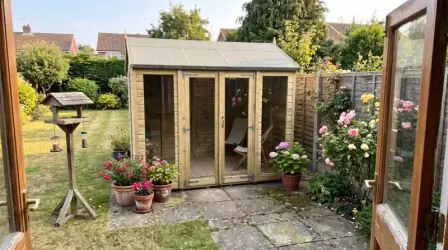
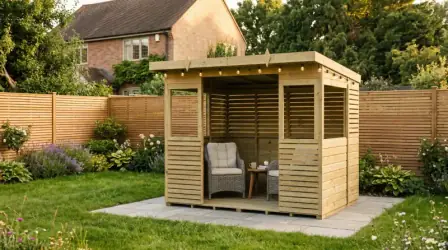
Nothing mysterious: a BBQ shed is a garden building — usually a pent, sometimes an apex — set up as a covered cooking and entertaining space. Where a storage shed gets shelving, a BBQ shed gets a prep bench at working height, a serving hatch where a window would sit, a dry home for the fuel, the fridge and the folding chairs, and openings arranged around one job: getting food from board to grill to plate without anyone standing in the rain.
Why bother in Britain? Because Britain is exactly where it earns its keep. Our rain arrives in instalments all year round, and even a fine July evening turns cool once the sun drops behind the fence. A covered prep-and-serve space keeps the cooking going through a shower, and the evening ends when you decide — not when the sky does.
The safety bit, said plainly
Before layouts, the rule we won't design around, soften or footnote: never cook with charcoal or gas inside an enclosed, unventilated building. A lit barbecue gives off carbon monoxide — invisible, odourless and lethal — and charcoal keeps producing it long after the flames die, all the way through the cool-down. A shed with the doors shut is the single worst place in the garden for a lit grill.
A proper BBQ shed respects that in one of two ways. The first is designing for air: double doors pinned flat back, a big serving opening, vents high and low, and the grill standing at the open threshold — the cook under the roof, the smoke rolling straight out into the sky. The second, and the version most of our customers actually build, is simpler: the building houses everything around the fire — prep, plating, fridge, fuel, seating — while the barbecue itself lives just outside on the slabs. Either way, the shed shelters the people and the food; the fire gets the open air it needs.
Four layouts that work
The serving-hatch side
A hinged hatch over a counter, facing the seating. Plates pass out, empties pass in, and nobody tramples the cook's corner. Hinge it at the top and it doubles as a little awning.
The galley prep bench
One long bench at working height down the building: board, bowls, trays and sauces in a line, one step apart, with fuel and covers stored underneath.
The open-front cook bay
Double doors pinned flat back turn the front into a sheltered mouth. The grill stands at the threshold — cook in the dry, smoke rolling straight out into open air.
Airflow designed in
Vents low on one wall and high on the opposite keep air moving even with the doors shut on an unlit building. Heat, steam and yesterday's smoke all want a way out.
How big does a BBQ shed need to be?
8x6 — the working minimum
- A full-length prep bench with storage underneath
- Grill, fuel and covers kept dry between cook-outs
- Cooking happens at the open door or just outside
- One cook works comfortably; guests stay in the garden
12x8 and up — the social space
- Prep bench at one end, table and chairs at the other
- Serving hatch or bar counter for passing plates
- Guests move inside the moment drizzle interrupts
- Room for a proper fridge and the radio
Timber or composite? Decide at the wipe-down
Barbecue smoke carries grease, and grease finds walls — it settles as a fine film on whatever is nearest the grill end, so choose your cladding with a cloth in mind.
Timber is the warm, traditional choice and takes fixings anywhere — tool rails, bottle openers, hat hooks. We build ours on tanalised, pressure-treated framing with a 20-year anti-rot guarantee; the answer to grease is a scrubbable interior finish on the cooking end, wiped down each season. Composite is the low-effort answer. The cladding wipes clean like a kitchen worktop, never needs painting, and carries a 30-year manufacturer warranty — worth a lot on a building that lives next to smoke and sauce. Browse the composite range to see it.
The roof over the cook
Heat, smoke and steam all rise, so the roof works harder here than on any storage shed. We fit EPDM rubber roofing — a single long-life membrane with a life expectancy of around 50 years, and no felt to lift or re-tack after a windy winter.
Lock it like you paid for it
A serious gas grill costs as much as a good bicycle and steals just as easily. Give the building a windowless side facing the access route and a solid hasp with a closed-shackle padlock, and keep the kit out of sight between cook-outs. Our security sheds show that thinking built in from the frame out.
Finishing touches
What turns a shed-with-a-barbecue into the place everyone gravitates to is a handful of small decisions: warm festoons on a dusk timer, a bottle opener screwed to the bench end, hooks for tongs and gloves at grill height, a chalkboard for the menu nobody follows. If your evenings lean more towards pouring than grilling, our garden bar guide is the sister read — the two builds share half their ideas. And when you're ready to put the hatch on the sunset side and the door where the path lands, the Build Studio lets you design the building panel by panel around your own garden.
Before the first cook-out
Pin this inside the door — the first two lines are the ones that matter.
- Doors pinned back and the hatch propped open before anything is lit
- Lit barbecue at the open threshold or outside — never behind closed doors
- Fire blanket and dry-powder extinguisher within arm's reach of the bench
- Fuel sealed, off the floor, and away from the grill end
- Prep bench clear; board, tongs and gloves laid out
- Fridge cold and stocked since morning
- Grill cooled, stowed and locked before you turn in
BBQ shed questions, answered straight
Can you use a barbecue inside a shed?
Not a lit one behind closed doors — ever. Charcoal and gas both give off carbon monoxide, which you can't see or smell, and charcoal keeps producing it while the coals cool. A BBQ shed works because of its openings: doors pinned back, a big hatch, vents high and low, the lit grill at the open threshold or outside. If the weather is too foul for that, it's too foul to barbecue.
Do I need planning permission for a BBQ shed?
Usually not. It's treated like any other garden building — normally permitted development, with the usual catch of a 2.5m maximum height within 2m of a boundary. Listed buildings and conservation areas carry extra rules.
What size should a BBQ shed be?
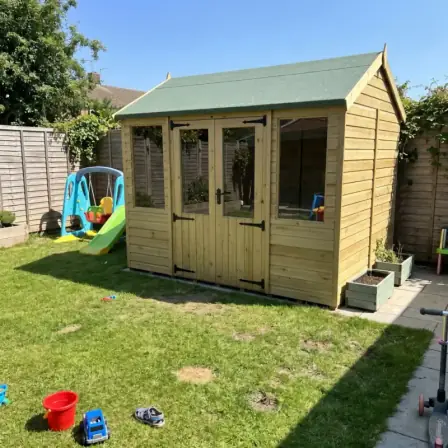
An 8x6 is the honest working minimum: a full prep bench, dry storage for grill and fuel, one cook in comfort. For a real social space — table and chairs in the dry, a serving counter, guests inside when it drizzles — start at 12x8.
Is timber or composite better for a BBQ shed?
Both work; they ask different things of you. Timber looks warmer and takes hooks and rails anywhere; a scrubbable interior finish handles the grease. Composite wipes down like a worktop and never needs painting. If you'd rather cook than maintain, composite edges it.
How do I stop the inside smelling of smoke?
Keep the fire at the opening, not in the room — smoke that never comes in never settles. Cross-ventilation does the rest: vents low on one side, high on the other. A wipe of the surfaces nearest the grill end each season stops the grease film building.
Design your BBQ shed around your garden
Hand-built in our West Midlands workshop since 1995, with free UK mainland delivery. Put the hatch on the sunset side and the bench where you want it — panel by panel, in the Build Studio.
Open the Build StudioReady to put it into practice? Every building is made in our West Midlands workshop with free mainland delivery.
Browse buildings →