Composite floor runners
Upgrade from the ground up.
Every garden building stands on its floor runners — the bearers under the floor boards that sit against the ground, in the damp, for the life of the building. Ours are pressure-treated timber as standard. Composite floor runners swap them for solid composite bearers that can never rot, warp or need treating. Out of sight. Built to last.
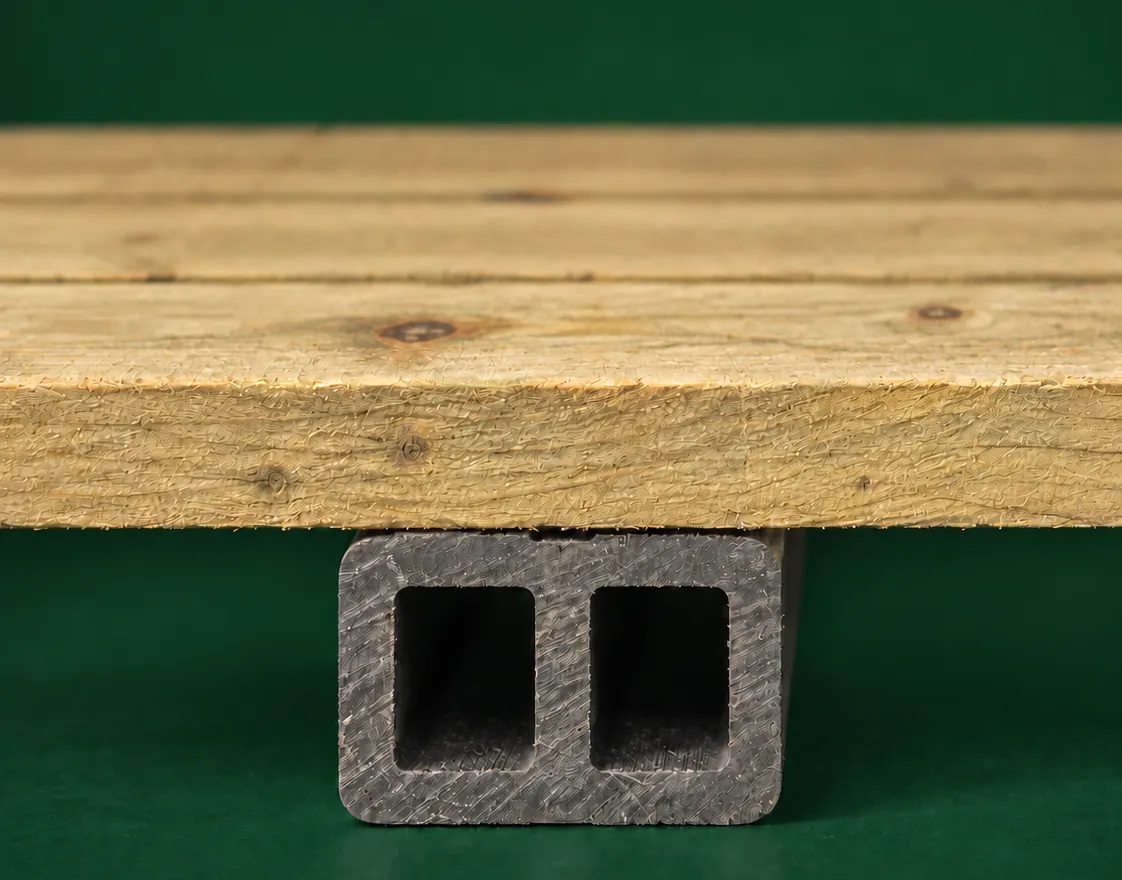
What a runner does
The runners carry the whole floor and everything on it, and they are the one part of the building that touches the base. On a timber shed they are also the part that works hardest against the damp — which is why, when a floor goes, it is usually the bearers that went first.
What changes — and what doesn't
Only the bearers change. The composite runners replace the timber ones like for like, so the floor boards stay the same pressure-treated timber, the building stays the same height, and nothing about the walls, roof or doors moves. They are an upgrade on every building we make — timber or composite, which both stand on timber bearers as standard.
The runner itself is an extruded wood-plastic composite section with two hollow chambers, in a near-black charcoal — the same family of material as our composite cladding, and just as indifferent to water.
Five reasons it matters
Can never rot
Wood-plastic composite has nothing in it for damp to attack. The part of the building that lives in the wet is the part that no longer cares.
Out of the damp
The runners hold the floor clear of the base so air moves underneath, instead of moisture sitting against the boards.
Nothing to treat
No re-treating, no checking under the floor every spring. Fitted once, finished for good.
Helps the floor last
Bearers fail first on any timber building. Take that failure out and the floor can last as long as the walls.
Any building, either material
Timber or composite, apex or pent, every size we make. Ticked in the Build Studio or on any sized product page.
What it costs
Priced by your floor area, the same price sale or no sale. Three examples — the Studio and every sized product page show the exact figure for your building.
6 × 4 ft
+£45
8 × 6 ft
+£90
12 × 8 ft
+£180
Common questions
Do composite buildings already have composite floor runners?
No. Every building we make — timber and composite — stands on pressure-treated timber bearers as standard, under a pressure-treated timber floor. Composite floor runners are an optional upgrade on both materials.
Do they change the floor, or the height of the building?
No. The floor boards stay the same pressure-treated square-edge timber, and the runners replace the timber bearers like for like underneath them — so the building’s floor and height are exactly as specified.
Do I still need a base?
Yes. Runners are the building’s own bearers, not a foundation — it still needs a firm, level, well-drained base. What changes is that the part of the building that meets that base can no longer rot.
How much are composite floor runners?
They are priced by your floor area — £90 on an 8 × 6, for example. The Build Studio and every sized product page show the exact figure for your building before you add it.
How do I add them?
Tick “Composite floor runners” under Finishing touches on any sized product page, or in the Extras step of the Build Studio. It is a single line on your order alongside the building.
Choosing the base itself? See what base do I need for a shed?
Out of sight. Built to last.
Composite floor runners · breathable membrane · pressure-treated timber · EPDM roofing — the stuff you can't see is the stuff that lasts.